

I wouldn’t treat “100% renewable energy” as proof of a lower climate footprint. I’d first check which factory it covers, how the power is sourced and when the claim was last checked.
As of 30 October 2026, the five brands report different levels of detail. UPSIDE Foods and Mosa Meat have made site-level renewable energy claims; Vow reports 100 kW of solar. GOOD Meat and Believer Meats leave power-sourcing questions unanswered.
Quick Comparison
| Brand | What the article reports | What I’d check next |
|---|---|---|
| UPSIDE Foods | Emeryville site described as using 100% renewable energy | How it buys power and which energy uses are covered |
| GOOD Meat | Singapore and US project plans, without a stated renewable share | Site status, electricity sources and dates |
| Mosa Meat | A 100% renewable energy claim alongside plans to investigate power options | Which buildings and production stages each statement covers |
| Believer Meats | No declared renewable-power plan; reported closure in December 2025 | Whether any production has resumed and how it is powered |
| Vow | 100 kW of solar reported at its Sydney site | Annual solar output and the source of remaining electricity |
My rule: <u>check the site, date and proof</u>. Then look beyond electricity: heat, energy use per kilogram and ingredient supply chains also shape the climate footprint. Missing figures mean I can’t confirm progress - not that renewable power is absent.
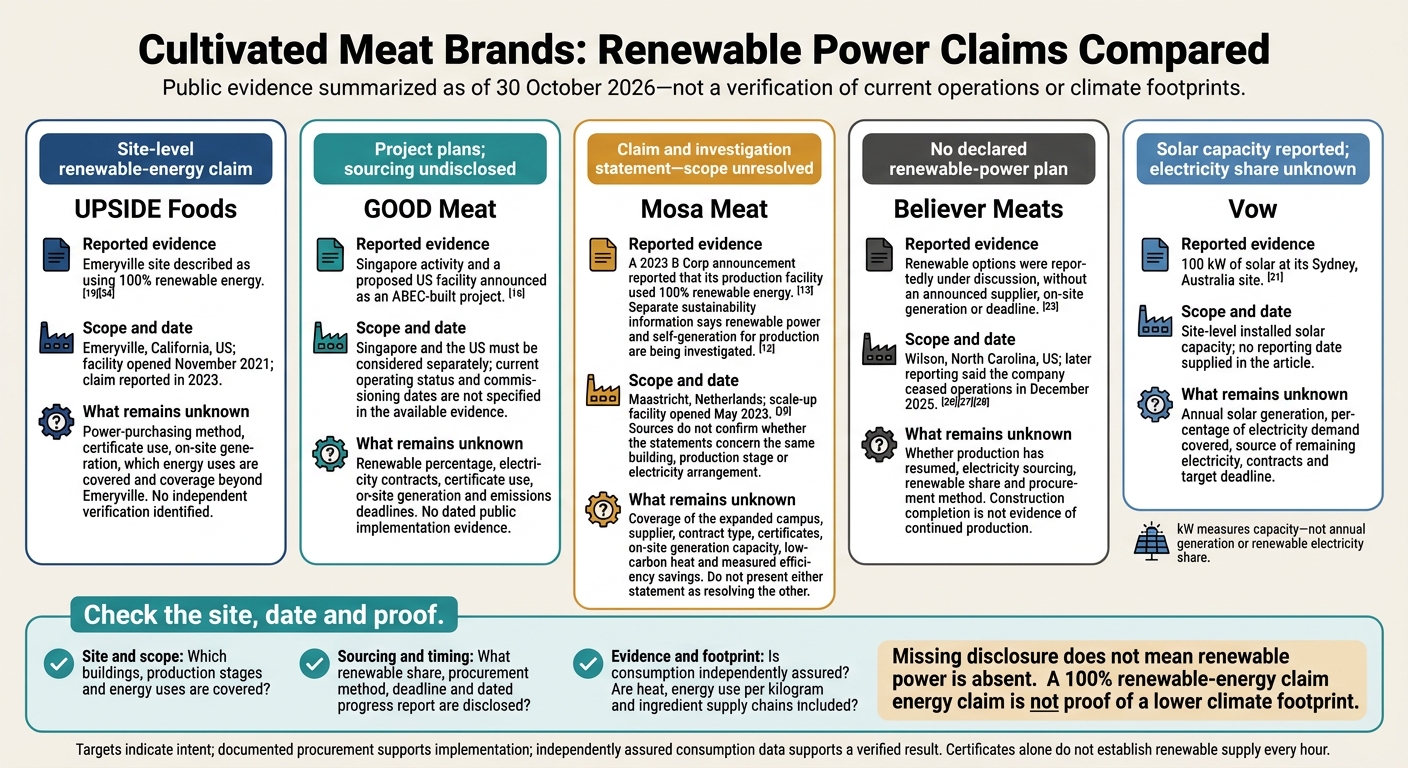
Cultivated Meat Brands: Renewable Power Claims Compared
UPSIDE Foods, GOOD Meat and Mosa Meat: Plans by region
The available evidence varies: UPSIDE Foods makes a site-level claim, GOOD Meat sets out project plans, and Mosa Meat provides partial disclosure.
UPSIDE Foods: Factory power commitments
UPSIDE Foods opened its Emeryville, California, facility in November 2021. The site is described as powered by 100% renewable energy.[10] That claim applies only to this site. Public sources do not specify how the energy is purchased, whether certificates or on-site generation are used, or whether the commitment extends beyond Emeryville.
GOOD Meat: Power sourcing in Singapore and the US
GOOD Meat’s Singapore activity should be considered separately from its proposed United States facility, announced as an ABEC-built project.[9] The available public evidence does not specify its current operating status or commissioning dates.
For either Singapore or the US, public sources do not specify renewable energy percentages, electricity contracts, certificate use, on-site generation or emissions deadlines.
Mosa Meat illustrates a key gap in this comparison: renewable energy claims and sustainability statements do not always refer to the same site or production stage.
Mosa Meat: Energy plans in the Netherlands
Mosa Meat opened a scale-up facility in Maastricht in May 2023.[11] Its 2023 B Corp announcement reported that its production facility used 100% renewable energy.[8] Separate sustainability information says the company is investigating renewable power and self-generation for production.[7]
These statements need to be read separately. The sources do not confirm whether they refer to the same building, production stage or electricity arrangement.
Public sources do not specify the electricity supplier, contract type, certificate use, on-site generation capacity, low-carbon heat source or measured efficiency savings. These factors are critical when using a cultivated meat sustainability calculator to determine environmental benefits. Shoppers therefore cannot yet match the renewable energy claim to the expanded campus or all company activities. A dated statement is needed that names the buildings covered and explains how their electricity and heat are supplied.
sbb-itb-c323ed3
Believer Meats and Vow: Power plans and missing details
Earlier brands disclosed some site-level power claims, but Believer Meats and Vow share fewer details. For shoppers, the question is whether each brand can show how its site is powered.
Believer Meats: US factory progress and power sourcing
Believer Meats chose Wilson, North Carolina, for its first US commercial-scale site, designed for large-scale production, but has not declared a renewable-power plan.[16][17] Later reporting said the company ceased operations in December 2025. Completed construction, then, does not show that production continued.[14][15][16]
Believer said it was discussing renewable options, but had not announced a supplier, on-site generation or a deadline.[13] Public reporting also leaves its renewable share and procurement method unspecified. Vow presents a similar gap: its site is known, but only part of its electricity sourcing is public.
Vow: Australian factories and electricity sourcing
Vow’s clearest public electricity detail is 100 kW of solar at its Sydney site.[12] That capacity alone does not tell shoppers how much of the site’s electricity demand solar covers. Public reporting does not specify its overall renewable percentage, electricity contracts or target deadline.
The next check is a dated site disclosure showing annual solar generation and where the remaining electricity comes from.
Brand comparison: Power pledges and progress
A reported claim is not the same as a sourcing plan or a verified result. The dates below reflect public evidence, not current arrangements. Compare scope, timing and proof, rather than the headline pledge alone.
The table distinguishes site-level claims, future plans and gaps in public reporting.
| Brand | Factory region | Renewable-power pledge | Power source or procurement method | Target timing | Evidence status | Key uncertainty |
|---|---|---|---|---|---|---|
| UPSIDE Foods | Emeryville, California, US | Site described as using 100% renewable energy.[10][18] | - | Reported in 2023.[10][18] | Site-level claim about energy use; no independent verification identified. | Procurement method and coverage of future commercial plants. |
| GOOD Meat | Singapore and the US | - | - | - | No dated public implementation evidence. | Site coverage and renewable share. |
| Mosa Meat | Netherlands | Investigating renewable-energy use and generation for production.[7] | Purchased renewable electricity or on-site generation under investigation; project and supplier not publicly specified.[7] | - | Investigation-stage statement, not evidence of implementation. | Site coverage, renewable share and verification method. |
| Believer Meats | Wilson, North Carolina, US | - | - | - | No dated public implementation evidence. | Electricity sourcing and renewable share. |
| Vow | Sydney, Australia | - | - | - | Solar capacity reported; overall renewable share unconfirmed.[12] | Site electricity mix and reporting scope. |
What supports a renewable-power pledge?
Look for a named site, a measurable electricity share, a named utility or renewable project, contract details such as a power-purchase agreement, a deadline and a progress report.
Each type of evidence tells you something different. A target shows intent. Documented procurement supports implementation. Independently assured consumption data supports a verified result. Electricity certificates can support annual accounting, but they do not prove renewable supply every hour. Their retirement and treatment must also prevent double counting.[3]
What renewable electricity does not prove
A 2023 CE Delft assessment modelled more favourable climate outcomes when renewable energy covered production and key supply-chain stages. Average global energy mixes produced less favourable comparisons with pork and chicken.[19]
These are modelled outcomes, not measured brand footprints. Electricity demand, process heat, factory efficiency and upstream ingredients still affect the results, alongside other cultivated meat challenges.[6]
What shoppers should check
Check which factory the claim covers, its renewable electricity share, the sourcing method, the deadline and a dated progress report. Look for independent assurance, and check whether heat and upstream ingredients are included or excluded. Use those details to judge what the claim actually supports.
Conclusion: Check delivery, dates and reporting
Check renewable-power claims against site coverage, dates and reporting. Without these details, shoppers can’t verify what a claim covers or how much it matters. This data is vital for understanding cultivated meat emissions and overall sustainability.[1]
FAQs
Can Cultivated Meat be low-carbon without on-site renewables?
Yes. Cultivated Meat can be low-carbon without generating renewable electricity on site [1][2]. Its carbon footprint depends largely on the electricity grid, because its main emissions come from electricity use rather than methane-producing livestock [3][2][4]. As the UK grid uses more wind and solar power, production emissions can fall without facilities generating their own renewable power - an advantage livestock farming cannot match [3][4][5].
Could renewable power affect Cultivated Meat prices?
Yes. Renewable power could help make Cultivated Meat more affordable. Energy use currently accounts for up to 95% of production costs because keeping bioreactor conditions precise takes a lot of energy.
Switching to renewable power and making production more efficient could cut those costs. Together with advances in bioreactor design and media optimisation, these changes are projected to bring production costs below £8 per kilogram by 2030, closer to conventional meat prices.
How can I spot misleading renewable energy claims?
Check how a company sources its energy and which production stages its claims cover. Cultivated Meat’s environmental footprint depends heavily on electricity. Claims of large emissions cuts may therefore overstate the gains if they leave out the regional electricity mix or the energy used to make growth media.
Also check whether claims draw on future projections or pilot-scale data. These often lack the clear, openly available evidence needed to verify claims of lower environmental impact today.


