

Cultivated meat could get cheaper as production grows - but bigger factories alone won’t cut prices. I’d check how many saleable kilograms a site produces, not just its tank size. And a forecast in £/kg is not necessarily the price you’ll pay in a UK shop.
I look at seven linked cost pressures:
- Small batches: fewer packs share the factory’s fixed costs.
- Slow factory expansion: new sites need time to reach planned output.
- Bioreactor limits: mixing, oxygen supply and cooling restrict cell growth.
- Specialist equipment: machinery and installation costs must be covered.
- Growth media: nutrients and growth factors add costs with each batch.
- Energy: cooling, heating and cleaning use power, even between runs.
- Quality checks and skilled staff: testing and safe production cost money at any batch size.
The numbers need context. One analysis estimated 77% lower basal-medium costs from bulk, food-grade ingredients - not 77% lower total production costs.
My rule? <u>Compare saleable output, factory use and what each price includes.</u> Lower factory costs may lead to cheaper packs, but packaging, chilled delivery and retail margins still count.
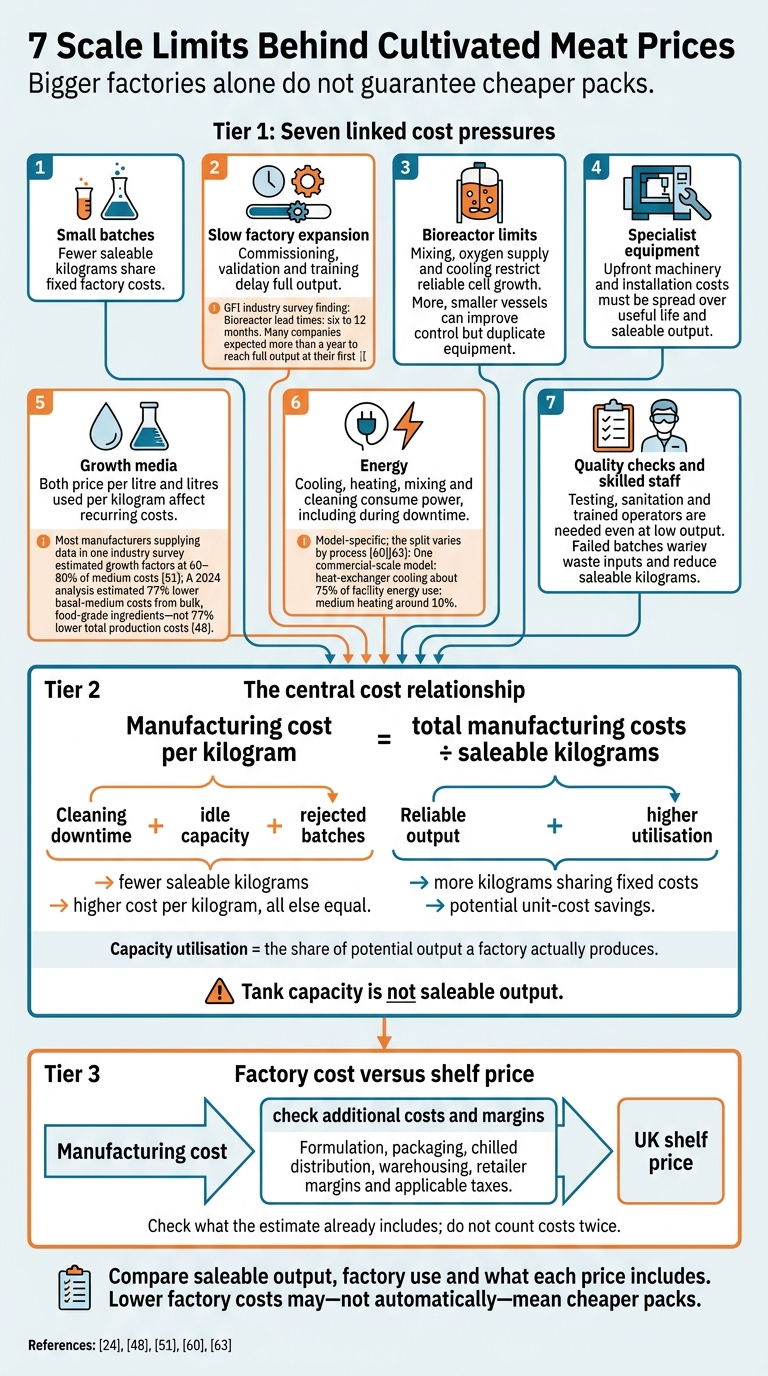
7 Scale Limits Behind Cultivated Meat Prices
Cost drivers of cultivated meat production
sbb-itb-c323ed3
Why Production Scale Affects Pack Prices
Fixed costs remain even when output falls. Buildings, cleanrooms and bioreactors still need funding and upkeep. Some costs increase with output; others stay the same. The calculation is simple: manufacturing cost per kilogram = total manufacturing costs ÷ saleable kilograms. Batch size alone therefore cannot explain the final pack price.
Capacity utilisation means the share of potential output a factory actually produces. Idle equipment, cleaning downtime and rejected batches leave fewer saleable kilograms to spread costs across, increasing the cost per kilogram. So consistent output matters more than vessel size alone.
More capacity does not guarantee lower costs. Extra vessels may need more cleanroom space, pipework, controls and specialist maintenance. If spending on equipment and upkeep grows faster than output, the cost per kilogram can increase.
Factory cost is also only one part of the shelf price. Formulation, packaging, chilled distribution, warehousing and margins all contribute. Check whether an estimate already includes packaging - and whether a forecast gives the factory cost, wholesale price or retail price.
1. Smaller Batches Leave Fewer Packs to Cover Costs
Early Cultivated Meat runs may produce too few packs to spread fixed costs across. What matters is how many saleable packs each batch delivers.[8][9] That directly affects the price per pack.
Larger-scale production and process improvements can cut costs, particularly when ingredients and equipment are bought in bulk.[11] But costs per pack only fall if production consistently delivers saleable output and the facility is well used.
When reading a price-cut announcement, look for evidence of regular, saleable output - not just one successful run. A high launch price may reflect production that is still ramping up, rather than the long-term price of Cultivated Meat.[7][6] Batch size is only one constraint, though: equipment scale also affects costs.
2. Slow Factory Expansion Delays Cost Savings
A new factory does not reach full output on day one. Savings from a larger site take time to arrive. After construction, teams still need to commission the site, validate processes and train staff. They also need tighter quality controls for testing, traceability and batch records.
GFI’s industry survey found bioreactor lead times of six to 12 months. Many companies also expected to take more than a year to reach full output at their first facility.[10] Each month spent ramping up means fewer saleable kilograms, pushing potential savings further back.
Validation takes time because mixing, oxygen transfer and heat removal change in larger vessels. Teams need repeated runs to confirm consistent results before they can support lower unit costs. Once processes are proven, trained staff and better scheduling can cut unplanned downtime. This lets existing equipment and quality systems support more production.
Check whether a price forecast accounts for this ramp-up period. Until output stabilises, the factory cannot deliver the savings expected from higher throughput. Once output is steady, the next constraint is how much each vessel can reliably produce.
3. Bioreactor Limits Restrict Output
The next constraint isn’t factory size. It’s how well each bioreactor performs.
A bigger tank does not automatically produce more Cultivated Meat. Oxygen dissolves poorly in culture media, so as cell density increases, demand can outstrip supply. Faster stirring helps distribute oxygen and nutrients, but uses more power and can damage fragile cells through the physical stress of mixing.[15][16]
Larger vessels can also develop uneven mixing and temperature differences. Cooling gets harder at scale, which can make growth less consistent and reduce output.[2][17] These limits push operators towards more, smaller vessels.
Smaller vessels can be easier to control than one giant tank. But each needs pumps, sensors, pipework and cleaning, and duplicating those systems increases the cost per kilogram.[6] Tank volume alone doesn’t determine usable output.
The Good Food Institute described oxygen carriers as one response to low oxygen, carbon dioxide build-up and mixing stress; it cited modelling in which high rotor speeds increased cell death, showing why more agitation is not always the answer.[16]
Better low-stress mixing, cooling and automated controls could increase output without bigger tanks. When assessing scale-up claims, look for key bioreactor metrics like saleable output per litre, per day - not tank capacity alone.
4. Specialist Equipment Needs Upfront Investment
Once vessel limits are clear, the next cost pressure is the equipment needed to run the plant. A Cultivated Meat facility needs more than bioreactor designs. Starter vessels, monitoring systems, sterile processing, water treatment, refrigeration and harvesting equipment all add to the upfront bill.[18][19]
The equipment is paid for upfront, but its cost is spread over its useful life. At low output, fewer saleable kilograms share that cost.
Higher utilisation brings down equipment cost per kilogram - even when the machinery costs the same. Reliable controls and effective cleaning systems help reduce downtime and failed batches, so the equipment gets more use. Single-use parts may cut cleaning time, but they also add recurring consumable costs.[12]
When reading a cost forecast, check assumed utilisation, equipment lifespan and saleable output, not just the purchase price.
5. Growth Media Add to Production Costs
Equipment isn’t the only expense that shapes pack prices. Growth medium is a major recurring cost, and its production also carries a significant environmental footprint. It contains water, glucose, amino acids, salts, vitamins and growth factors. Both its price per litre and the litres used per kilogram affect production costs.[13]
Growth factors are often the most expensive ingredient in the medium, especially at small scale. In one industry survey, most manufacturers who supplied data estimated that growth factors made up 60–80% of medium costs.[21]
Buying in bulk and using cheaper formulations could help. A 2024 analysis estimated that replacing basal-medium ingredients with bulk, food-grade equivalents could cut basal-medium costs by 77% - not total production costs.[20] Any replacement must still meet growth, safety and regulatory requirements.
When checking a cheaper-medium claim, look at whether the price assumes manufacturing-scale purchasing and how many litres the cells use per kilogram of Cultivated Meat. A lower price per litre saves less if the cells need more medium per kilogram.[13]
6. Energy Demand Adds to Running Costs
Power is a recurring cost that can increase per kilogram when output is low. A Cultivated Meat facility needs electricity for temperature control, mixing, aeration, pumps, monitoring, sterilisation and water treatment.[22][24]
Cooling can dominate energy use: one commercial-scale model put heat-exchanger cooling at about 75% of facility energy use and medium heating at around 10%, though the split varies by process.[23][24]
When output is low, these energy-heavy systems serve fewer saleable kilograms, pushing up the energy cost per kilogram. Cleaning between batches uses energy while no Cultivated Meat is being produced. Equipment left running during idle periods also consumes power without adding output.
Efficient chillers, pumps, insulation and heat recovery could cut energy use , similar to how nutrient recovery reduces waste costs, without weakening required process controls. Lower-carbon electricity may cut emissions, but it reduces energy costs only if it is also cheaper. When reading price forecasts, check factory utilisation and electricity-price assumptions: renewable power does not automatically mean cheaper pack prices.
7. Quality Checks and Skilled Staff Cost More per Kilogram at Low Output
Even with energy use under control, labour and testing push up the cost per kilogram at low output. Small Cultivated Meat batches still need trained operators and quality specialists.[25][26]
Preventing contamination means paying for controlled production areas, sanitation, protective clothing and environmental monitoring. Some of these costs are fixed, so smaller batches leave fewer saleable kilograms to cover them. Before release, checks may assess product identity, microbiological safety and composition, depending on the product and its authorised process. These checks take staff time regardless of how much is produced.[25][26]
Testing materials and cleaning supplies add variable costs too. Discarding a batch compounds the problem: it wastes materials and staff time while cutting saleable output.[25][26]
Producing more could spread shared costs across more kilograms. Automation may allow staff to supervise more production, but people still need to investigate unusual results and decide whether to release a batch. When reading cost forecasts, look for higher staff productivity and fewer failed batches - not weaker safety checks.[2][25][26]
How Equipment Scale Changes Production Costs
Once vessel performance is set, the next question is how much that capacity costs to install. Scale changes more than reactor size, particularly when transitioning between stainless steel and single-use systems. It also changes the utilities, controls and hygienic processing areas needed around it.[27][14]
Equipment savings need to be weighed against installation costs. The scale bands below are planning benchmarks, not fixed standards.
| Equipment scale | Upfront cost | Potential pricing effect | Production benefit |
|---|---|---|---|
| Pilot equipment | Lower total investment, but relatively high equipment costs per litre. | Little scope for equipment savings per kilogram. | Tests growth, feeding, harvesting and cleaning before commercial scale. This phase is critical for refining how cultivated meat is made at volume. |
| Larger commercial vessels | High upfront spending on reactors and shared systems. | Lower unit costs only if utilisation stays high. | More output per vessel, but mixing, oxygen transfer and heat removal become more demanding. |
| Multiple-vessel facilities | Several reactors, with duplicated controls, pipework and maintenance needs. | Duplication can offset the gains from phased expansion. | Allows staggered harvests and maintenance, with scope to run different products. |
A successful pilot run does not show the full installed cost of a commercial site.[27][28] Multiple vessels give producers more flexibility, but shared utilities or downstream equipment can still limit output.[14][5]
Check what each forecast measures: bare vessel cost, installed site cost or cost per kilogram of saleable product. Litres measure capacity, not saleable output. When output is low, fewer kilograms must cover the fixed equipment costs.[14][28]
How to Read Cultivated Meat Cost Forecasts
Scale affects cost, but so does the way a forecast is built. A techno-economic analysis (TEA) estimates manufacturing costs under stated assumptions. It may leave out packaging, chilled distribution, retailer margins and launch costs, so it is not a UK shelf price.[5] Check the study’s publication date, not the article’s date: a 2021 model remains a 2021 forecast even when cited later.
Next, check whether the model assumes commercial-scale production. Look at vessel size and cell performance together. Reactor design, growth rate, cell density and usable harvest yield all affect output. Lab results do not prove that the same performance is possible at commercial scale. Check the growth-media price and how much is used per kilogram. For energy, look for agitation, oxygen supply, sterilisation, cooling and harvesting, and check whether the model uses UK electricity prices.
Annual output should allow for cleaning, maintenance, failed batches and ramp-up. A mature factory running at high utilisation is not the same as a new plant still building up production. Financing matters too. Leaving out depreciation, borrowing costs or construction overruns can make an estimate look cheaper without improving the process.
Compare cost figures only after checking the original studies and which equipment they cover. Any US$ estimate converted into £/kg should show the exchange-rate source, date and calculation alongside it.[29] Converting the currency does not adjust overseas energy, labour or construction assumptions to UK conditions.
Conclusion: Lower Prices Are Possible, Not Guaranteed
Early Cultivated Meat prices may reflect seven linked cost pressures: small batches, slow factory ramp-up, bioreactor limits, specialist equipment, growth media, energy and labour-intensive quality control. These constraints can push up launch prices, but they don’t fix prices forever.
Running factories closer to capacity, reducing failed batches and improving engineering could spread costs over more kilograms. Buying media ingredients and consumables in bulk could help too.
But lower factory costs don’t automatically mean lower UK shelf prices. Packaging, distribution, retailer margins and taxes still apply. Savings also depend on reliable commercial production, so how government grants and production costs influence how far prices might fall - and when - remains uncertain.
FAQs
When could Cultivated Meat become affordable in the UK?
Cultivated Meat is not yet available for retail sale in the UK. Analysts expect it to become much more affordable by 2030, with projected costs of around £5–£10 per kilogram as production shifts from small batches to large-scale, continuous manufacturing.
Early commercial roll-outs are expected around 2028. Cultivated Meat Shop notes that supermarket availability will expand after initial launches in restaurants and specialist outlets.
Could some Cultivated Meat products become cheaper sooner than others?
Yes. Hybrid products, which combine Cultivated Meat with plant-based ingredients, and unstructured products such as burgers or sausages are expected to reach competitive prices sooner. They contain fewer cultivated cells, making them cheaper to produce as the technology matures.
Early standalone products may cost more because they’re produced on a small scale. Improvements in growth media, bioprocessing and cell engineering are expected to bring more options to UK households over time.
How can I tell whether Cultivated Meat price forecasts are realistic?
Check whether forecasts account for growth media costs, bioprocess efficiency and cell line performance [1][2]. Realistic models assume large cuts in media costs - which currently make up 55–95% of production expenses - through food-grade, serum-free formulations [1][3].
They should also account for the move from small-scale, stop-start batch processing to large-scale, continuous manufacturing in bioreactors exceeding 20,000 litres [4][1][2].


