

Cultivated chicken offers a way to enjoy meat while reducing its environmental impact. It’s made by growing chicken cells in bioreactors, eliminating the need to raise and slaughter animals. This process uses less land and water, avoids harmful emissions from manure, and can significantly lower greenhouse gas emissions when powered by renewable energy.
Key points to know:
- Lower emissions: Can produce fewer emissions than beef and pork, and comparable emissions to efficient chicken farming with clean energy.
- Resource-efficient: Uses up to 83% less land and recycles water during production.
- Cleaner production: Reduces air pollution, agricultural runoff, and phosphorus waste.
- Availability: Not yet sold for human consumption in the UK but is moving through regulatory approvals.
Cultivated chicken could soon become a practical choice for reducing your carbon footprint without changing your diet.
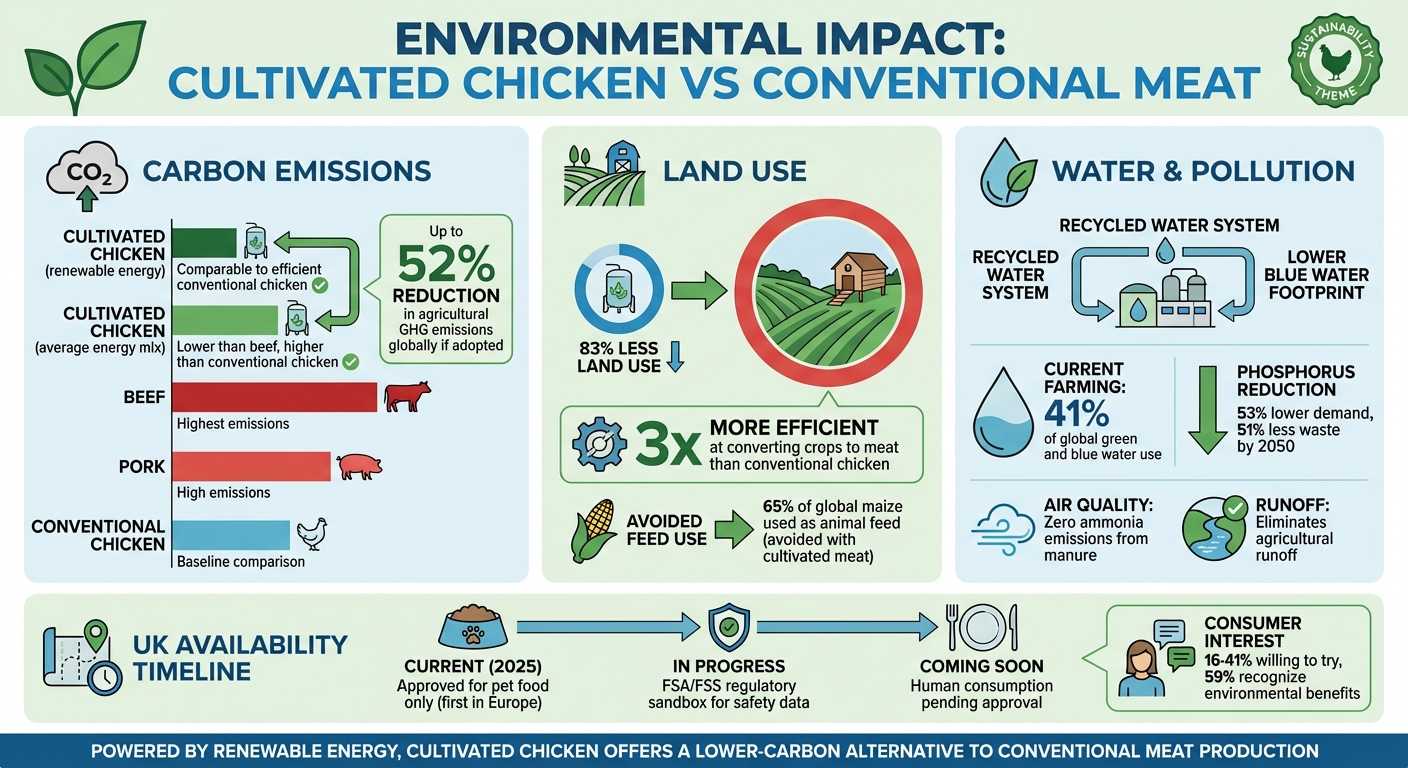
Environmental Impact Comparison: Cultivated Chicken vs Conventional Meat
How Cultivated Chicken Reduces Carbon Emissions
Carbon Footprint Comparison
The environmental impact of cultivated chicken largely hinges on how it's produced. When renewable energy powers its production, the carbon footprint can match that of efficiently produced conventional chicken. On the other hand, using an average energy mix results in emissions lower than beef but still higher than conventional chicken. Traditional poultry farming releases methane and nitrous oxide through manure, while cultivated chicken primarily generates carbon dioxide due to its energy demands.
As researchers from CE Delft noted:
"CM has the potential to have a lower environmental impact than ambitious conventional meat benchmarks... The carbon footprint is substantially lower than that of beef. How it compares to chicken and pork depends on energy mixes." [4]
Key contributors to cultivated chicken’s emissions include the energy required to maintain bioreactor temperatures and the production of culture medium ingredients. These factors highlight how critical the choice of energy sources is in shaping its overall emissions profile.
The Role of Renewable Energy in Production
Pelle Sinke from CE Delft highlighted the importance of clean energy:
"Using renewable energy, the carbon footprint is lower than beef and pork and comparable to the ambitious benchmark of chicken." [4]
As the UK continues to decarbonise its electricity grid, the environmental advantages of cultivated chicken are set to grow. Unlike traditional farming, this method removes manure-related methane emissions but depends heavily on clean electricity. Additionally, transitioning from pharmaceutical-grade to food-grade culture medium ingredients could cut upstream emissions even further. These developments position cultivated chicken as a promising low-emission choice for UK consumers.
Other Environmental Benefits of Cultivated Chicken
Lower Land and Water Requirements
Cultivated chicken not only reduces carbon emissions but also makes better use of resources like land and water. By improving the efficiency of converting crops into meat, it significantly cuts the need for large agricultural spaces.
"Cultivated meat is almost three times more efficient in turning crops into meat than chicken, the most efficient animal, and therefore agricultural land use is low." – Pelle Sinke, Researcher, CE Delft [4]
If the world shifted to cultivated meat production by 2050, land use could drop by an impressive 83% [3]. This is because there’s no need for grazing pastures or growing massive amounts of feed crops. Currently, about 65% of global maize is used as animal feed [3]. Cultivated chicken avoids this entirely by growing meat directly in compact bioreactor facilities, which take up far less space than traditional poultry farms and their infrastructure.
Water use also becomes much more efficient. Cultivated chicken’s production process recycles water, cutting down its blue water footprint. In contrast, traditional animal farming accounts for 41% of global green and blue water use [4]. Life cycle assessments show that cultivated meat uses less blue water than most conventional meats, including poultry [4][2]. This efficiency not only conserves vital resources but also helps reduce pollution in local ecosystems.
Cleaner Air and Reduced Pollution
Cultivated chicken is produced in sterile bioreactors, which eliminates a major source of ammonia emissions and fine particulate matter. This can lead to noticeable improvements in air quality [4].
The production process also prevents agricultural runoff, a common issue in traditional farming. Switching to cultivated meat could lower phosphorus demand by 53% and reduce phosphorus waste by 51% by 2050 [3]. With fewer crops needed, there’s less reliance on fertilisers, which means reduced chemical runoff into rivers and lakes. Bioreactor systems are highly precise, ensuring nutrients are used efficiently and minimising environmental leakage. This controlled approach helps protect waterways and keeps ecosystems healthier.
What UK Consumers Should Know About Cultivated Chicken
Current Availability in the UK
At the moment, cultivated chicken isn't available for purchase in UK shops or restaurants. Before it can hit the shelves or menus, it must gain approval from the Food Standards Agency (FSA) and Food Standards Scotland (FSS), as it's classified as a novel food [5].
To pave the way for this, the UK government has introduced a regulatory sandbox. This initiative helps the FSA and FSS collect safety data and create clear guidelines for regulating such products [5][6].
"The sandbox is a dialogue programme where the FSA and FSS will work with industry, academic bodies, and other experts to gather knowledge about these products to inform our regulatory approach." – Food Standards Agency [5]
Interestingly, in 2025, the UK became the first European country to approve cultivated meat, though only for pet food at this stage [7]. This cautious, step-by-step approach suggests human consumption could follow once all safety checks are completed. Surveys show that between 16% and 41% of UK consumers are open to trying cultivated chicken, and 59% see its potential to improve animal welfare and reduce environmental impact [6]. With regulatory approval likely on the horizon, it's worth keeping an eye on these developments.
How to Stay Informed
As the regulatory process unfolds, staying informed will help consumers stay ahead of the curve. For those interested, Cultivated Meat Shop provides educational materials, industry updates, and even a waitlist for the latest news [1].
The FSA website (food.gov.uk) is another valuable resource. It tracks the progress of the Cell-Cultivated Products Sandbox Programme and maintains a register of authorised novel foods. When cultivated chicken passes all safety checks, it will appear on this list [5][6].
Look out for clear labelling on authorised products, such as "Cultivated Meat", and disclosures about any genetic modifications [5][6].
sbb-itb-c323ed3
How lab-grown meat could help the climate - On the Green Fence
Conclusion: A Lower-Carbon Future for Meat
Cultivated chicken provides a more efficient alternative to conventional poultry by converting crops into meat almost three times more effectively [4]. This efficiency not only reduces the need for agricultural land [3] but also eliminates issues like manure emissions and nitrogen pollution associated with traditional livestock farming [4].
While the production process is energy-intensive, using renewable energy allows cultivated chicken to achieve a carbon footprint comparable to the best-performing conventional chicken options [4]. And when compared to beef or pork, its footprint is significantly smaller. On a global scale, adopting cultivated meat could cut agricultural greenhouse gas emissions by as much as 52% [3]. These environmental benefits position cultivated chicken as a strong contender to replace traditional meat in everyday meals.
"Consumers should consider CM [cultivated meat] not as an extra option on the menu, but as a substitute to higher-impact products." – Pelle Sinke, Researcher, CE Delft [4]
For UK consumers, cultivated chicken offers a familiar taste and nutritional profile while delivering a much smaller environmental impact. As awareness of these benefits grows, this innovation could become a simple way to reduce your carbon footprint without giving up the foods you love.
To stay updated on when cultivated chicken will be available in the UK and to explore the latest environmental insights, visit Cultivated Meat Shop. You can also join the waitlist for early access and see how this development could play a role in creating a lower-carbon future for meat.
FAQs
How does cultivated chicken help lower greenhouse gas emissions?
Cultivated chicken offers a promising way to cut down on greenhouse gas emissions, as it requires far less land, water, and energy than traditional poultry farming. Its efficient production process has a much smaller environmental footprint, with research suggesting emissions could drop by as much as 52% when renewable energy is part of the equation.
By eliminating the need for large-scale livestock farming, cultivated chicken helps reduce deforestation, methane emissions, and other harmful by-products. This makes it a cleaner, more environmentally friendly option compared to conventional meat production.
What environmental advantages does cultivated chicken have over traditional poultry farming?
Cultivated chicken stands out as a more eco-friendly option compared to traditional poultry farming. It uses up to 83% less land, cuts greenhouse gas emissions by more than 50%, and dramatically reduces water consumption.
These benefits are largely due to its streamlined production process, which skips the resource-heavy demands of large-scale animal farming. Often powered by renewable energy sources, this approach positions cultivated chicken as a promising low-carbon solution for meat production in the years ahead.
When will cultivated chicken be available for consumers in the UK?
Cultivated chicken is expected to reach UK consumers by approximately 2030. This timeline comes from a life cycle assessment published in early 2023, which indicates that commercial-scale production could be a reality by then.
In the meantime, platforms like Cultivated Meat Shop are playing a key role in getting consumers ready for this future. They provide insights into the environmental impact, health aspects, and potential of cultivated meat. While these products aren't on shelves just yet, staying informed now means you'll be prepared for this groundbreaking shift in food production.


