

Livestock farming is a leading cause of biodiversity loss. It drives habitat destruction, contributes to climate change, and pollutes ecosystems. Key issues include:
- Land Use: Livestock takes up 30% of Earth's land and causes 41% of global deforestation, particularly in regions like the Amazon.
- Pollution: Animal waste and feed production lead to water contamination, eutrophication, and air pollution, harming aquatic and terrestrial species.
- Overgrazing: Grasslands are degraded, leading to soil erosion and loss of plant diversity.
- Climate Impact: Livestock accounts for 14.5% of human-induced greenhouse gas emissions, with methane being a major contributor.
- Wildlife Fragmentation: Infrastructure like roads and fences disrupt migration and isolate species, reducing genetic diversity.
With global meat demand projected to rise by 50% by 2050, these impacts are expected to worsen. Solutions include improved farming techniques, rotational grazing, and alternatives like cultivated meat, which could reduce land use, emissions, and pollution compared to beef while preserving biodiversity.
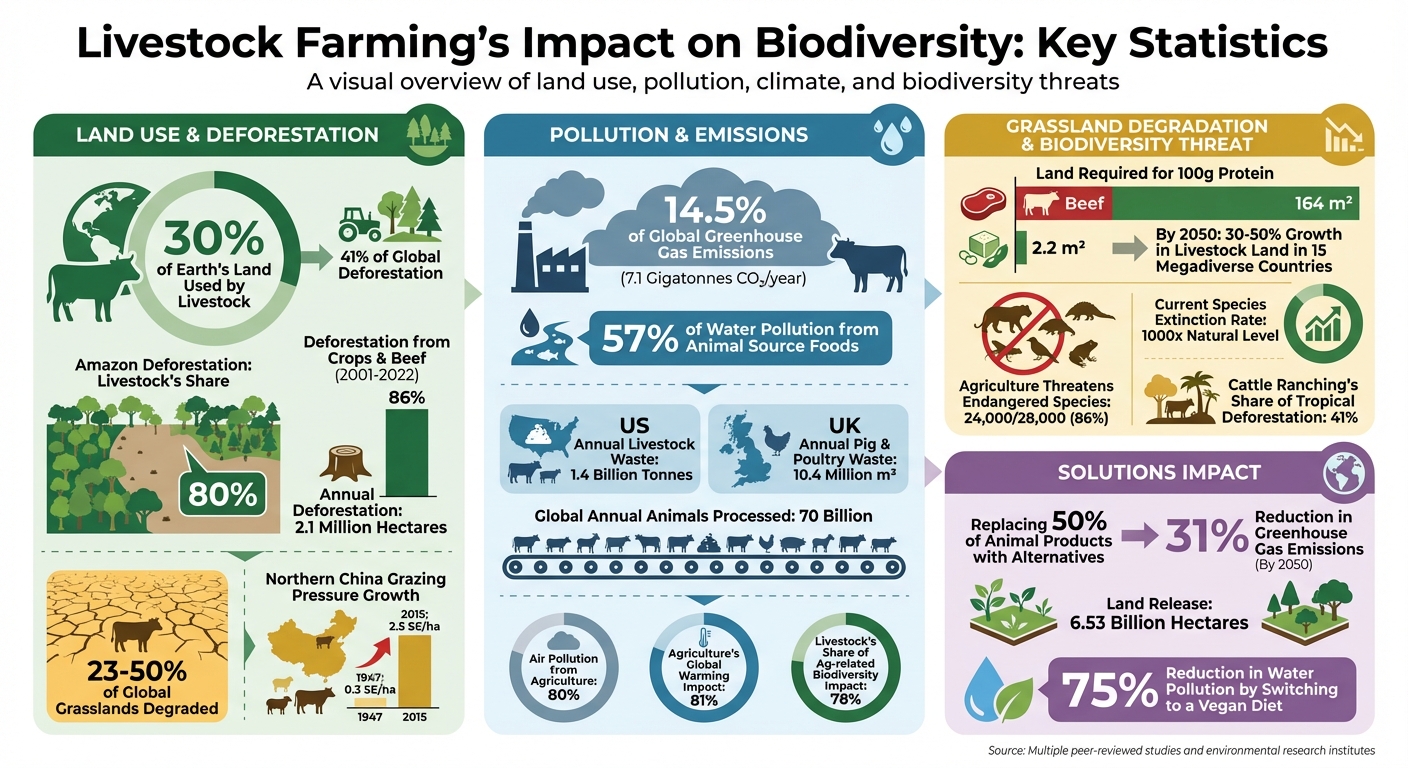
Livestock Farming's Impact on Biodiversity: Key Statistics
Habitat Loss and Fragmentation
Deforestation for Grazing and Feed Crops
Livestock farming drastically alters ecosystems, often permanently. Cattle ranching alone accounts for a staggering 80% of deforestation in the Amazon. Globally, land cleared for grazing and feed crops contributes to 41% of deforestation - equivalent to 2.1 million hectares annually [3].
From 2001 to 2022, crop and cattle production were responsible for 86% of global deforestation [7]. In the Amazon, more than three-quarters of previously cleared land is now dedicated to livestock pasture or feed crops [6].
"Once forests are converted to grazing land, they rarely return to their original state."
The issue extends beyond grazing. A staggering 85% of the world's soybean crop is processed into meal for animal feed, rather than being consumed directly by humans [8]. This shift replaces biodiverse habitats with monoculture plantations, stripping the land of the variety of food sources and shelter that wildlife relies on [4]. The contrast in land use is stark: producing 100g of protein from beef requires 164 m² of land, compared to just 2.2 m² for tofu [8].
Geophysicist Gidon Eshel from Bard College highlights the global scale of the problem:
"Now we can say, only slightly fancifully: You eat a steak, you kill a lemur in Madagascar. You eat a chicken, you kill an Amazonian parrot."
- Gidon Eshel, Bard College [6]
Looking ahead, the situation is set to worsen. By 2050, in 15 megadiverse countries - those home to the highest numbers of endemic species - land used for livestock production is expected to grow by 30% to 50% [6].
And it’s not just deforestation. The infrastructure supporting livestock farming contributes to further habitat fragmentation.
Disrupted Wildlife Corridors and Migration
Livestock-related infrastructure doesn’t just clear forests - it also fragments the remaining habitats. Roads, fences, and other developments divide landscapes, cutting off wildlife from traditional migration routes, breeding grounds, and vital resources [3].
This fragmentation isolates wildlife populations, increasing the risk of inbreeding and reducing genetic diversity, which leaves species more susceptible to disease [3]. Central and South America are particularly affected due to their high concentration of rare, narrow-ranged species [1]. When animals are confined to small, isolated patches of habitat, entire populations can become unsustainable over time.
Fragmentation also pushes wildlife into less hospitable areas or even human settlements in search of food, leading to conflicts between humans and animals [3]. As noted in Nature:
"Livestock rearing on land is one of three key drivers behind land-use change and the single largest driver of habitat loss."
- Nature [5]
sbb-itb-c323ed3
The Hidden Climate Killer: How Animal Farming Destroys the Planet with Gerard Bisshop
Pollution from Livestock Farming
Livestock farming takes a heavy toll on the environment, harming land, water, and air. With around 70 billion animals processed globally every year, the waste they produce is roughly double that of the entire human population [9]. This massive output of pollutants not only damages ecosystems but also worsens biodiversity loss, adding to the challenges of habitat destruction and fragmentation.
Water Pollution from Animal Waste
Animal waste is a major contributor to water pollution, releasing nitrogen and phosphorus into rivers, lakes, and groundwater. This triggers eutrophication, a process where nutrient overloads cause algal blooms that deplete oxygen levels in aquatic systems, making them uninhabitable for many species [3]. Globally, animal-derived food products are responsible for 57% of water pollution [8]. In the United States alone, livestock and poultry produce a staggering 1.4 billion tonnes of waste annually [3].
In the UK, pig and poultry farms generate 10.4 million cubic metres of waste each year [10][11]. Due to the high costs of transporting manure, it’s often spread within a five-kilometre radius of farms, creating concentrated "nutrient hotspots" that overwhelm the soil's natural capacity to absorb nutrients.
This waste is not just a nutrient problem - it also carries serious health risks. Pathogens like E. coli and Salmonella, along with antibiotics, growth hormones, and heavy metals such as copper and zinc, are often present [9][3]. One tragic example is the 2000 Walkerton, Ontario incident, where manure runoff contaminated the water supply with E. coli O157:H7, leading to over 2,300 illnesses and seven deaths [8].
Feed crop production adds to the contamination. In the UK, 34–38% of the wheat crop is grown specifically for pig and poultry feed, involving 2,621 tonnes of pesticides that often wash into waterways during rainfall [11][12]. Studies suggest that switching to a vegan diet could reduce water pollution by as much as 75% [8].
"Assessment of the environmental impacts of pig and poultry production to date has largely focussed on the immediate risks of slurry pollution, but this research looks for the first time at the wider risks across the whole UK sector – in particular the vast land take for feed production."
- Barnaby Coupe, Senior Land Use Policy Manager, The Wildlife Trusts [10]
The consequences of mismanaged livestock waste are not confined to isolated incidents. For example, in July 2025, Spain's High Court of Galicia ruled that authorities had violated residents' human rights by allowing decades of pollution from industrial pig and poultry farms near the Las Conchas reservoir. Immediate action was ordered to stop the environmental damage [9]. That same year, the European Union referred Spain to the Court of Justice after severe algal blooms in the Mar Menor lagoon were linked to nutrient runoff from intensive pork production [9].
Air Pollution and Greenhouse Gases
Livestock farming doesn’t just harm water - it’s also a significant source of air pollution. The sector is responsible for 14.5% of global greenhouse gas emissions, equivalent to 7.1 gigatonnes of CO₂ annually. Cattle production alone accounts for roughly two-thirds of these emissions [3]. Methane, released during digestion in ruminants, makes up over half of the livestock sector’s emissions [3]. Over a 20-year period, methane has 81 times the global warming potential of carbon dioxide [8].
The sector also generates 80% of all agricultural air pollution and contributes 81% of agriculture’s global warming effects [13]. This pollution is a key driver of biodiversity loss, with 78% of agriculture-related biodiversity impacts linked to the livestock industry [13]. Ammonia and nitrogen oxides from livestock operations form secondary particulate matter (PM₂.₅) and tropospheric ozone, both of which harm vegetation and reduce plants’ ability to absorb carbon [13]. Additionally, nitrogen deposition from ammonia causes soil acidification and eutrophication, which lowers species diversity in terrestrial habitats [13].
| Food Type | Acidifying Emissions (g SO₂eq per 100g protein) |
|---|---|
| Beef | 343.6 |
| Cheese | 165.5 |
| Pork | 142.7 |
| Poultry | 102.4 |
| Eggs | 53.7 |
| Tofu | 6.7 |
Source: Wikipedia [8]
The air pollution caused by livestock farming not only accelerates climate change but also further undermines already fragile ecosystems. With global meat consumption expected to double between 2000 and 2050 [8], these environmental pressures will only grow unless the industry undergoes fundamental changes in its practices.
Overgrazing and Soil Degradation
Livestock farming doesn’t just pollute - it also harms grassland ecosystems by overgrazing. This practice strips away plant cover and weakens soil health, creating a ripple effect of environmental damage. Alarming statistics reveal that between 23% and 50% of the world’s grasslands are now considered degraded [5]. Overgrazing occurs when too many animals graze the same land for extended periods, removing the vegetation that stabilises the soil and triggering a chain reaction of ecological harm.
Vegetation Loss and Soil Erosion
When overgrazing strips away vegetation, the topsoil loses its natural shield against wind and water. This makes the soil vulnerable to erosion, which can eventually lead to desertification [4][16]. The problem is even more severe in dry regions, where ecosystems are less resilient to grazing pressure.
Research shows that long-term grazing has a devastating impact on desert steppes in arid areas, while its effects are less pronounced in wetter meadow steppes [15]. In arid environments, grazing intensity must be carefully managed, with biomass removal kept between 0% and 20% depending on the site’s dryness [5]. Unfortunately, many grasslands exceed these limits. For instance, in Northern China, grazing pressure has surged dramatically - from 0.3 SE/ha in 1947 to 2.5 SE/ha by 2015 - leading to widespread degradation [15].
The consequences of vegetation loss go beyond bare soil. It disrupts vital ecosystem processes like water retention, nutrient cycling, and carbon storage [16]. In arid regions, overgrazing shifts plant communities towards annual species that grow poorly and offer little soil stability [15]. This shift not only reduces the land’s ability to support diverse wildlife but also undermines its ecological balance. Even below the surface, the damage continues, as overgrazing weakens the soil’s microbial network, which is crucial for recovery and long-term health.
Reduced Soil Microbial Diversity
The damage caused by overgrazing extends to the very microbes that keep soil healthy. Livestock trampling compacts the soil, reducing its pore space and harming microbial diversity, which is vital for nutrient cycling [14]. This compaction particularly affects rare microbial species that play a key role in sustaining the below-ground food web [14].
"Soil biodiversity regulates a number of key ecosystem functions and services, for instance organic matter decomposition, plant nutrient availability, nutrient leaching, and soil structural stability."
In grazed grasslands, soil biodiversity becomes the main driver of ecosystem functions, unlike in ungrazed areas where plant diversity plays a larger role [15]. This shift highlights how overgrazing reshapes ecosystems at a fundamental level. When soil microbial communities are compromised, the land struggles to decompose organic matter, recycle nutrients, and maintain its structure - all essential functions for healthy grasslands.
A study spanning 10 experimental sites across a range of aridity levels found that grazing significantly reduced ecosystem functionality in arid desert steppes, while meadow steppes with higher moisture levels were less affected [15]. This underscores the importance of aridity in determining the extent of overgrazing’s impact on soil and ecosystem health.
Biodiversity Hotspots Under Threat
Biodiversity hotspots, known for their incredible variety of endemic species, are under increasing strain due to livestock farming. The expansion of agricultural land in these regions often results in irreversible habitat destruction. Unlike other forms of deforestation, which sometimes allow forests to recover, land cleared for pastures rarely returns to its original state. When these habitats vanish, entire species can be lost forever [3].
These regions, especially within the 15 megadiverse nations, are already feeling the effects of rapid industrial livestock growth [6]. The link between rising meat consumption and threats to biodiversity is more direct than many might think.
Amazon Rainforest and African Savannas
Cattle ranching is responsible for a staggering 80% of deforestation in the Amazon, releasing around 340 million tonnes of carbon annually [3]. The impact doesn’t stop with the rainforest - soy farming is also expanding at an alarming rate. In the Brazilian Amazon, soy-growing areas have more than tripled since 2008, adding 7.28 million hectares [17]. What’s striking is that 80% of this soy isn’t for human consumption but is used to feed livestock [17].
A concerning development occurred in late 2025 and early 2026 when ABIOVE, a Brazilian industry association that includes companies like JBS, Bunge, Amaggi, and Cofco International, announced it would no longer comply with the Amazon Soy Moratorium. This agreement had previously prohibited the purchase of soy grown on land deforested after 2006. According to research by the Brazilian Amazon Environmental Research Institute (IPAM), this decision could lead to a 30% increase in Amazon deforestation by 2045 [17]. In response, 14 major European retailers, including Lidl and Aldi, vowed to stop sourcing soy from these suppliers unless the entire supply chain could be fully traced.
The threats seen in the Amazon are mirrored in other crucial ecosystems. The Brazilian Cerrado, a woodland savanna, has already lost over half its area to cattle ranching and soy farming [6]. Similarly, African savannas are facing growing risks as industrial livestock operations expand across the continent [6]. These regions are home to species that exist nowhere else, making habitat destruction a severe blow to global biodiversity.
Alternatives to Reduce Biodiversity Threats
There are practical ways to tackle issues like habitat destruction, pollution, and overgrazing. Two key approaches include improving livestock farming techniques and exploring alternative protein production methods.
Improved Livestock Practices
Adopting better farming methods can significantly reduce livestock's impact on the environment without needing to abandon animal agriculture altogether.
- Rotational grazing: By limiting biomass removal to 10–20%, this practice allows pastures to recover, protects against erosion, and supports native plant species [5].
- Silvopasture systems: Combining trees with grazing areas improves soil health, offers shade for animals, and restores habitats for wildlife [18].
- Anaerobic digesters: These systems process manure to reduce nutrient runoff and create renewable energy [16].
While regenerative grazing shows promise, studies suggest it may require 2.5 times more land than conventional beef production and may not deliver as many climate benefits as initially thought [21].
Cultivated Meat as an Alternative
Another promising solution lies in alternative protein production, particularly cultivated meat. This method involves growing real meat from cells, offering a way to address biodiversity challenges without the environmental drawbacks of traditional livestock farming. Cultivated meat could significantly reduce the land and water demands of agriculture [20].
For example, research published in Nature reveals that replacing just 50% of major animal products like beef, pork, chicken, and milk with alternatives could cut agriculture-related greenhouse gas emissions by 31% by 2050. This shift could also free up around 653 million hectares of land, meeting 13–25% of global land restoration goals by 2030 and helping to prevent further declines in ecosystem health [20].
Cultivated meat production also eliminates the large amounts of manure produced by conventional farming, thereby reducing water pollution and minimising the creation of coastal dead zones. It helps counteract overgrazing, which often leads to soil degradation and loss of plant diversity. Furthermore, it could nearly halt deforestation and the conversion of natural land by 2050, particularly in vulnerable regions like the Amazon [4][2][20].
Although cultivated meat is not yet available commercially in the UK, platforms like Cultivated Meat Shop are working to educate consumers about this emerging technology. By offering engaging resources and previews of future products, they aim to prepare people for a shift toward sustainable meat production that meets nutritional needs while preserving natural ecosystems.
Conclusion
The threats outlined earlier make it clear that meat production, as it stands, demands a complete overhaul. Livestock farming is a major driver of biodiversity loss, with agriculture endangering a staggering 86% of species currently at risk of extinction [22]. Cattle farming alone is responsible for 41% of tropical deforestation [19], and extinction rates today are 1,000 times higher than natural background levels [22].
"Our global food system is the primary driver of biodiversity loss, with agriculture alone being the identified threat to 24,000 of the 28,000 (86%) species at risk of extinction." – United Nations Environment Programme [22]
If no changes are made, current meat production methods will continue to destabilise ecosystems critical to life on Earth. While improved livestock practices, such as rotational grazing and silvopasture, offer some benefits, they are limited by the amount of land and resources required to implement them effectively.
Given the scale of the problem, innovative solutions are urgently needed. Cultivated meat presents a promising alternative, directly addressing the inefficiencies of conventional meat production, such as food waste. As previously discussed, the cumulative impact of habitat destruction, pollution, and overgrazing highlights the need for immediate action. By reducing the demand for traditional livestock, cultivated meat has the potential to restore vital habitats and protect species in regions like the Amazon, where biodiversity is under severe threat.
Although cultivated meat is not yet available in the UK, platforms such as Cultivated Meat Shop are laying the groundwork by educating consumers and showcasing the possibilities of this emerging technology. By combining improved farming methods with forward-thinking alternatives, there is a practical way to meet global nutritional needs while preserving biodiversity. This transformation is crucial to protecting the ecosystems that sustain all forms of life.
FAQs
How does livestock farming drive species extinctions?
Livestock farming plays a significant role in driving species extinctions by destroying natural habitats. Forests, wetlands, and other ecosystems are often cleared to create space for grazing or to grow feed crops, forcing many species out of their homes and drastically reducing biodiversity. Beyond habitat loss, overgrazing, soil degradation, and pollution caused by livestock farming further weaken ecosystems, stripping them of genetic diversity and resilience. With the rising global demand for meat, these issues are only getting worse, cementing livestock farming as a leading cause of biodiversity loss and a major contributor to species extinction.
Which pollutants from livestock harm rivers and seas the most?
Nutrients such as nitrogen and phosphorus, found in livestock manure and slurry, are among the most damaging pollutants. When these substances enter water systems, they can trigger eutrophication - a process that leads to algal blooms and depletes oxygen in rivers and seas. This chain reaction can have devastating effects on aquatic ecosystems, harming both plant and animal life.
Can Cultivated Meat really reduce deforestation and land use?
Cultivated meat offers a promising way to cut down on deforestation and the extensive land use associated with traditional livestock farming. Right now, over two-thirds of agricultural land is dedicated to growing feed for livestock, while less than 10% is used to produce food directly for people. Shifting to cultivated meat, which demands much less land, could help minimise habitat destruction, protect biodiversity, and ease the strain on ecosystems - not just in the UK but globally.


