

Cultivated pork is grown from animal cells, not farmed animals, but it delivers a taste and texture that closely resembles pork as we know it. Here's what you need to know:
- Taste: It shares the same "savoury", "meaty", and "fried" notes as conventional pork. Studies show most people find it hard to tell the difference in flavour.
- Texture: While the fat structure differs slightly, consumer tests rate the texture as comparable, especially in ground products like sausages or burgers.
- Cooking: It cooks like pork, developing rich flavours through grilling, frying, or roasting. "Bacon-like" aromas are a standout feature.
- Appearance: Visually similar to pork, though marbling in whole cuts is still being fine-tuned.
Early testers and chefs agree that cultivated pork offers a satisfying and familiar eating experience, particularly in ground or processed formats. It's a promising option for anyone looking for a more ethical way to enjoy pork without sacrificing flavour or quality.
'The animal this is made from is still alive': Guardian Australia taste-test cultivated meat

sbb-itb-c323ed3
Cultivated Pork vs Conventional Pork
Cultivated Pork vs Conventional Pork: Taste, Texture, and Appearance Comparison
Cultivated pork and conventional pork are remarkably similar when it comes to muscle and fat tissues, though there are minor structural differences - particularly in the fat. These distinctions open the door to comparing their taste, texture, and overall appearance.
Taste and Flavour
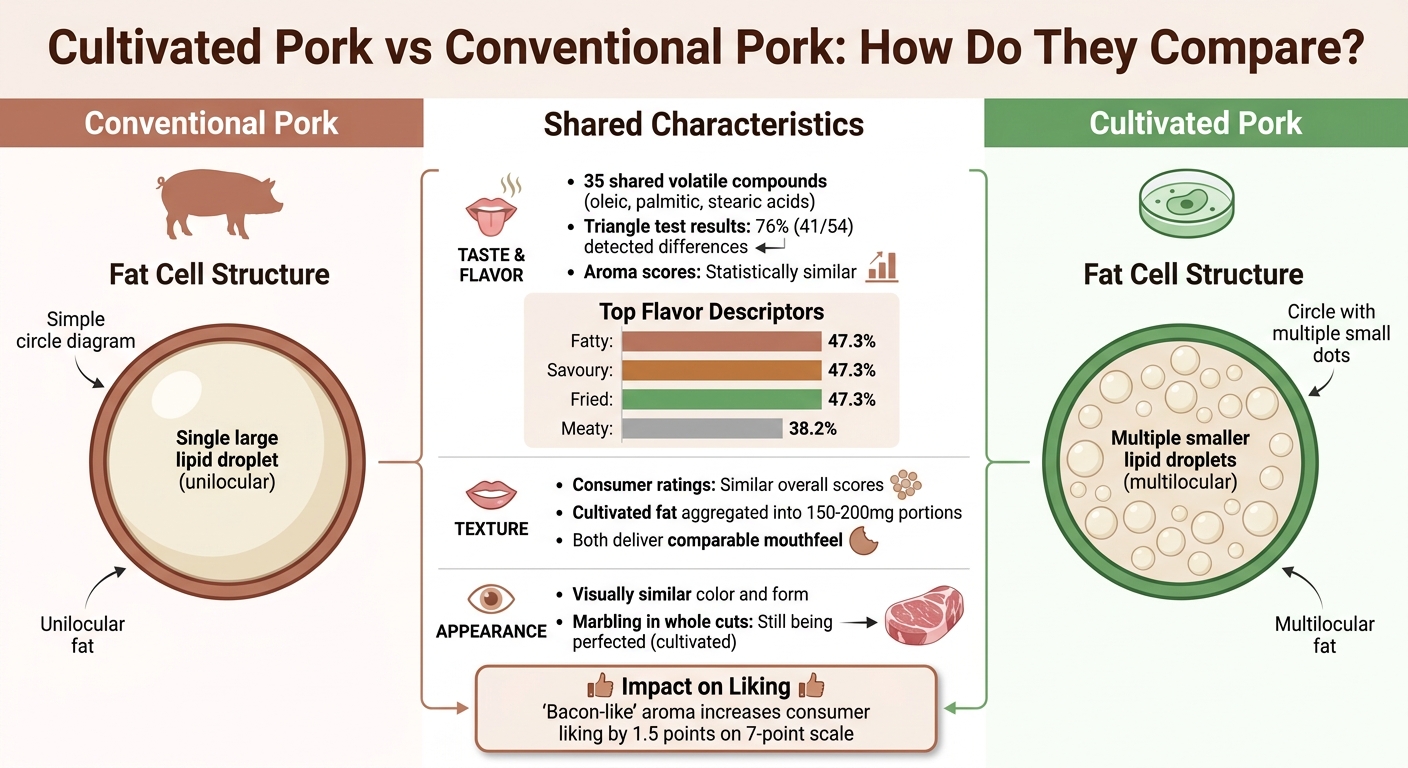
The flavour of cooked pork comes from volatile compounds. A Tufts University study from July 2024 found that both cultivated and conventional pork fats share 35 volatile compounds, including oleic, palmitic, and stearic acids. During a triangle test with over 50 participants, 41 out of 54 (about 76%) correctly identified the difference between the two samples. However, the overall scores for aroma were statistically similar. Both types of fat were described using terms like "fatty" (47.3%), "savoury" (47.3%), "fried" (47.3%), and "meaty" (38.2%) [1].
"The volatile profiles generated during the cooking process and fatty aroma characteristics reported by sensory consumers were largely similar between the two fat sources, with some differences in select compounds and aroma attributes." - Scientific Reports [1]
One notable difference was that cultivated fat had slightly higher levels of "musty" or "barnyard" aromas, which researchers attribute to current production methods. For instance, solvents like DMSO used in the cultivation process may contribute to these off-notes. Efforts are underway to address this, including testing alternative methods and using antioxidants like ascorbic acid to minimise these odours [1].
Texture and Mouthfeel
When it comes to texture, the differences become more apparent. Conventional pork fat cells are unilocular, meaning they contain a single large lipid droplet, while cultivated pork fat cells are multilocular, with multiple smaller droplets. This reflects an immature fat structure. To make the fat usable, cultivated fat cells are mechanically combined into small tissue portions (around 150–200 mg) that mimic the texture of native pig fat. Despite these structural differences, consumer tests showed that both types of fat received similar overall texture ratings [1].
Appearance and Presentation
Visually, cultivated pork fat closely resembles conventional fat. The aggregation process helps replicate the natural colour and form. However, because of its immature structure, achieving perfect marbling remains a work in progress [1].
The Taste Profile of Cultivated Pork
Flavour Notes
Cultivated pork closely mirrors the flavour of traditional pork, thanks to its identical muscle and fat cells. When cooked, it releases the same volatile compounds that give pork its signature taste. In sensory trials, participants often described it as savoury (50%), with strong "fatty" (47.3%), "fried" (47.3%), and "meaty" (38.2%) characteristics [3].
Fat content is key to delivering flavour, and cultivated pork offers an advantage here. With controlled fat distribution, producers can ensure consistent juiciness and flavour release - something that traditional farming, influenced by factors like animal stress or diet, can't always guarantee. This consistency not only enhances the taste but also ensures the meat performs predictably across various cooking methods.
While some early samples have shown minor off-notes, ongoing production refinements are addressing these issues. However, the core flavours remain robust and adaptable to a variety of cooking techniques.
How Cooking Methods Affect Taste
Cultivated pork provides a solid flavour base that develops further during cooking. Through processes like the Maillard reaction and caramelisation, it achieves the same rich, savoury notes as conventional pork. Different cooking methods add unique layers to the flavour.
- Grilling and roasting: These methods create "roasted" and "bacon-like" flavours, which significantly enhance consumer enjoyment. In fact, sensory trials showed a 1.5-point increase in overall liking on a 7-point hedonic scale when the "bacon-like" note was present [3].
- Frying: This method brings out distinct "fried" aromas. At around 120°C, aldehydes, alcohols, and furans are released, producing the familiar "cooked meat" smell that diners love.
Chefs have noted that cultivated pork works seamlessly with marinades and seasonings, just like traditional meat. Current offerings, such as ground pork for burgers and sausages, perform consistently across cooking methods, making them easy to use in familiar recipes. Whether grilled, fried, or roasted, cultivated pork delivers the taste and versatility that cooks expect.
Product Formats and Taste
Ground Products vs Whole Cuts
The format of cultivated pork plays a big role in its taste and texture. Ground products - like sausages, burgers, and meatballs - are currently the most reliable when it comes to delivering consistent flavour. This is because they bypass the need for the intricate alignment of fibres, fat, and connective tissues required for whole cuts [5].
"Taste testers have reported that cultivated meat nuggets and burgers are comparable to conventional products, particularly in formats where the meat is seasoned or combined with other ingredients." [2]
Ground formats also have a key advantage: fat can be evenly distributed, ensuring consistent juiciness throughout. In contrast, whole cuts demand precise fat cell placement within structural scaffolds to recreate the marbling seen in traditional meat [5].
Whole cuts, however, are much trickier to replicate. Skeletal muscle is made up of around 90% muscle fibres, with the remaining 10% being fat and connective tissue [5]. Mimicking the natural "grain" and mouthfeel of a classic roast requires advanced scaffolding techniques and mechanical stimulation - a level of complexity that ground products simply avoid [5][2].
These differences in structure also affect how seasonings interact with the meat, which has a noticeable impact on the overall flavour.
Flavour Enhancement in Prepared Products
Cultivated pork's natural flavour profile makes it a great base for absorbing herbs and spices. Seasonings like black pepper, rosemary, and sage pair particularly well, especially in ground formats where they spread evenly throughout the product [4]. Chefs have noted that cultivated pork takes well to marinades and common cooking techniques, making it easy to use in familiar recipes [2].
Interestingly, consumers have picked up on a "bacon-like" note in the flavour, which has been a hit in taste tests. Additionally, the cultivated fat within the pork acts as a flavour carrier, releasing aromatic compounds at around 120°C to deliver that signature "pork" aroma [1].
Feedback from Experts and Early Testers
Expert Opinions
Culinary experts have noted the striking similarity of cultivated pork to traditional pork. In April 2024, Meatable organised a tasting event at its headquarters in Leiden, Netherlands, showcasing a mini-bratwurst containing 28% cultivated pork fat. Jonathan Chadwick, Assistant Science & Technology Editor for the Daily Mail, described the flavour as "smokey" and distinctly "piggy", with no trace of an artificial aftertaste.
"There was a distinctive piggy flavour – smokey with a touch of farmyard, but with no chemical tang of laboratory as I'd feared." [7]
Earlier, in October 2023, Meatable hosted its first media tasting at the Love Handle Labs Innovation Centre in Singapore. This event featured hybrid sausage and pulled pork tacos made from a mix of one-third cultivated pork and two-thirds plant-based protein. Lynda Hong from The Straits Times observed that while the pulled pork had a softer, less fibrous texture that melted in the mouth faster than traditional pork, the sausage was almost indistinguishable from a conventional bratwurst.
Consumer Reactions
Consumer feedback aligns closely with expert opinions. Early testers frequently report difficulty in distinguishing cultivated pork from its traditionally farmed counterpart, particularly in processed products like sausages. Many have praised the "porky" flavour, noting how closely it resembles conventional pork.
"It can be hard for someone to tell the difference between traditional pork and cultivated pork." – Lynda Hong, The Straits Times [6]
The overall takeaway from early tastings is clear: while there may be slight differences in texture for certain formats, the flavour of cultivated pork convincingly mirrors that of traditional pork.
Conclusion
Cultivated pork achieves the same taste and texture as conventional pork because it’s real meat, grown directly from animal cells. Its cellular structure mirrors that of traditional pork, and when cooked, it undergoes Maillard reactions and caramelisation, releasing those familiar smoky, savoury aromas and delivering the juicy mouthfeel we associate with pork.
Expert tastings and early consumer feedback highlight that cultivated pork is nearly indistinguishable from conventional pork, particularly in ground and processed forms. While whole-cut options are still being perfected using advanced scaffolding techniques, the current products already showcase a texture that closely matches traditional meat. This makes cultivated pork a reliable option for everyday meals.
One of cultivated pork’s standout features is its consistency. Unlike conventional pork, which can vary due to factors like the animal’s diet, stress, or handling, cultivated pork maintains uniform quality in every batch. Producers can even tailor fat profiles to improve juiciness and add beneficial nutrients like Omega-3 fatty acids.
"Cultivated meat isn't an imitation or alternative to conventional meat – it's real meat, just produced through a different method." [2]
This consistency ensures that cultivated pork behaves just like traditional pork in the kitchen. It absorbs marinades, responds to seasonings, and works perfectly with all the classic cooking methods. As a true one-to-one replacement, it blends seamlessly into familiar recipes, offering a sustainable and ethically produced option without sacrificing flavour or quality.
FAQs
Will cultivated pork taste exactly like regular pork?
Cultivated pork is designed to replicate the taste and texture of traditional pork as closely as possible. While there are slight differences - like a gentler umami flavour, reduced bitterness, and a softer, more consistent texture thanks to the controlled way it’s produced - continuous progress is being made to bring it even closer to the experience of conventional pork.
Why does cultivated pork sometimes have a slight 'farmyard' smell?
Cultivated pork might sometimes carry a faint 'farmyard' scent. This is due to its gentler aroma and simpler flavour profile when compared to traditional pork. The controlled production process plays a role here, as it doesn't involve the same compounds found in conventional farming environments.
When will whole cuts like chops or belly taste and look right?
As cultivated meat technology continues to evolve, whole cuts like chops or belly are anticipated to more closely mimic traditional meat. Although early attempts have faced hurdles in recreating the texture and appearance of these cuts, ongoing progress is steadily refining these qualities.


