

When it comes to meat, UK consumers are increasingly balancing their choices between cost, quality, and sustainability. Here's what stands out:
- Younger generations are leading the shift: Half of 16–34-year-olds have reduced or stopped eating meat, driven by health and environmental concerns.
- Animal welfare matters: 47% believe Cultivated Meat could improve animal welfare, and 54% value traceable supply chains.
- Sustainability is growing in importance: While still secondary to price and quality, it’s influencing purchasing decisions.
- Cultivated Meat is gaining attention: 26% are open to trying it, but concerns about cost, taste, and its "naturalness" remain barriers.
- Price is a key obstacle: 40% expect Cultivated Meat to cost more than traditional options, limiting its appeal amidst cost-of-living pressures.
For sustainable meat to gain traction, clear communication, affordability, and addressing misconceptions will be essential. Cultivated Meat offers promise, but it faces hurdles in public perception and accessibility.
The future of meat? Inside the Oxford-based startup turning cells into 'steaks'
sbb-itb-c323ed3
UK Consumer Trends in Sustainable Meat
Sustainability has become a crucial consideration for UK shoppers, standing alongside price, quality, and convenience. Lumina Intelligence notes that while "sustainability now sits below value and quality in consumer priorities, becoming more of a consideration than a primary driver," it still plays an important role in shaping purchasing decisions [4]. This is particularly evident in how consumers approach meat, with growing attention to environmental and ethical factors driving their choices.
Environmental and Health Motivations
Younger generations are at the forefront of this shift. A significant 50% of UK consumers aged 16–34 have either reduced or completely stopped eating meat [3]. Their decisions are largely motivated by environmental and health concerns. Interestingly, 46% of UK adults - rising to 63% among those under 35 - prioritise sustainable ingredients over whether a product is minimally processed [3]. This openness suggests that many are willing to embrace food-tech innovations if they believe these solutions offer meaningful environmental benefits.
"Sustainability benefits therefore hold promising potential for counterbalancing UPF concerns. This is good news for plant-based dairy and meat substitutes." - Alice Baker, Food and Drink Analyst, Mintel [3]
Animal Welfare and Transparency
Animal welfare remains one of the strongest motivators for sustainability-focused consumers in the UK. Nearly half - 47% of Britons - believe Cultivated Meat will improve animal welfare compared to conventional farming [2]. Similarly, 43% expect it to be more environmentally friendly [2]. Beyond emerging technologies like Cultivated Meat, there is a growing demand for transparency in traditional supply chains. For instance, 54% of UK consumers associate provenance with a traceable supply chain [4], and 36% are willing to pay extra for food that provides clear information about its origins [4]. Features like named farms, regional sourcing, and verifiable claims are becoming key factors influencing buying decisions.
Consumer Segments and Trade-offs
UK consumers can be broadly grouped into three categories:
- Eco-conscious eaters, who prioritise environmental impact above other factors.
- Health-driven reducers, who are cutting back on meat primarily for personal health reasons.
- Food-tech enthusiasts, a group dominated by younger men, who are open to innovations like Cultivated Meat as practical solutions.
Interestingly, men are more inclined to try Cultivated Meat than women, with 36% of men expressing interest compared to just 16% of women [2]. This highlights a noticeable gender divide in the adoption of food technology.
However, price remains the biggest challenge across all consumer groups. 40% of UK consumers expect Cultivated Meat to be more expensive than traditional meat [2]. With cost-of-living pressures expected to persist into 2025 and 2026, many shoppers are hesitant to prioritise sustainability if it means higher costs. To resonate with these consumers, brands must tie environmental benefits to everyday value, rather than focusing solely on the premium price of sustainable choices.
How UK Consumers View Meat Alternatives
Plant-Based Meat Alternatives: Consumer Views
Plant-based meat alternatives have become a staple in UK supermarkets, but consumer reactions are mixed. Many shoppers are drawn to these products for their perceived environmental benefits. However, some health-conscious individuals remain cautious, pointing to concerns about processed ingredients and long lists of additives. Interestingly, among non-meat eaters - the primary audience for plant-based options - 82% say they would likely avoid Cultivated Meat [2]. This hesitation seems tied to how people define "meat", as much as to environmental or health considerations. Unlike plant-based options, Cultivated Meat encounters unique challenges, particularly around taste and its "naturalness", which has led to efforts to educate the public. These varied opinions on plant-based products provide valuable context for understanding the growing interest in Cultivated Meat in the UK.
Cultivated Meat: An Emerging Option in the UK
Cultivated Meat, which is grown from animal cells without the need for slaughter, is still a relatively new concept for many UK consumers. Awareness is gradually increasing, and many see its potential benefits for the environment and animal welfare [2]. While 26% of Britons say they would likely try Cultivated Meat if it were available, concerns about solving taste challenges and cost linger. Only 3% expect it to taste better than conventional meat, and current meat-eaters (27%) are far more open to trying it than non-meat eaters (10%) [2]. For some, the perception of Cultivated Meat as "unnatural" remains a significant psychological hurdle [1].
"The meaning of cultured 'meat' in an environmental context may appeal to those who are already familiar with it, while it will be important to explain cell culture technologies outside of the meat category to those who are hesitant about it." - Aiko Hibino, Institute of Future Science [1]
How Cultivated Meat Shop Supports Consumer Awareness
As opinions about meat alternatives continue to evolve, clear communication is key. Cultivated Meat Shop plays a crucial role in addressing consumer doubts. Research shows that only 14.3% of UK consumers are firmly against trying Cultivated Meat [1], meaning there’s a significant group of curious but hesitant individuals. Cultivated Meat Shop helps bridge this gap by offering easy-to-understand, jargon-free information about how Cultivated Meat is produced, its sustainability and animal welfare benefits, and what consumers can expect. Through product previews, waitlist sign-ups, and educational articles, the platform is preparing UK consumers for a future where Cultivated Meat is both accessible and widely understood.
How Consumers Rate Different Meat Options on Sustainability
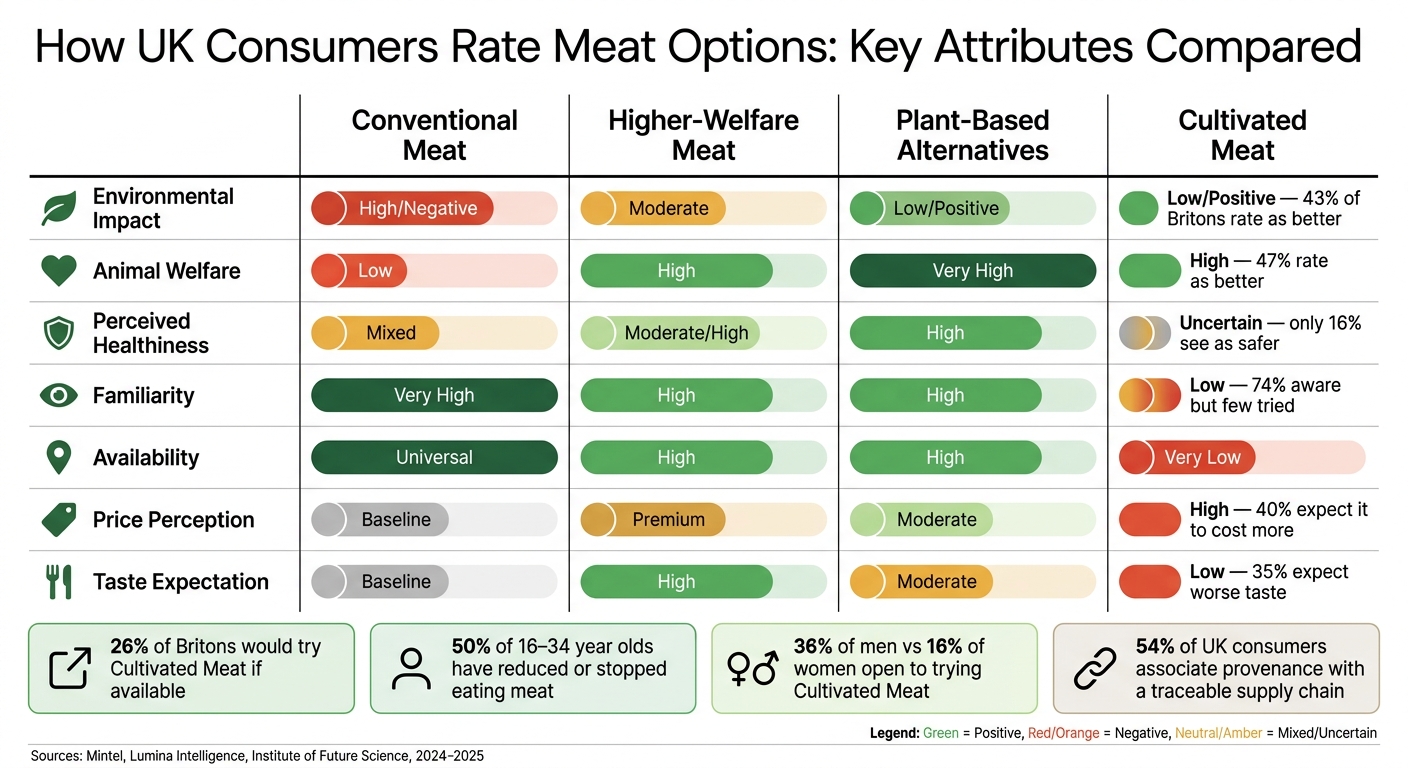
UK Consumer Attitudes to Meat Options: Sustainability, Welfare & Price
Consumer Views on Sustainability Across Meat Types
When it comes to sustainable meat options, UK consumers weigh environmental impact and animal welfare as top priorities [2]. These considerations aren't just theoretical - they directly influence how people perceive products, from the chicken at their local shop to the promise of Cultivated Meat.
Conventional meat tends to rank the lowest in sustainability. While it’s trusted for taste and widely available, it’s also strongly associated with high environmental damage and poor animal welfare. Options like free-range or organic meats improve ethical perceptions, but they come with higher costs and still carry an environmental burden. Plant-based alternatives, on the other hand, perform well in both environmental and animal welfare categories. However, their often processed nature leaves some consumers cautious.
Cultivated Meat occupies a unique spot in the conversation. Surveys reveal that 43% of Britons see it as more environmentally sustainable and 47% rate it higher in animal welfare compared to traditional meat [2]. But when it comes to health and safety, opinions shift: only 16% believe Cultivated Meat will be safer to eat than conventional meat, while 27% think it could be less safe [2].
Dietary preferences also play a role in shaping these views. Non-meat eaters are notably more optimistic about Cultivated Meat’s environmental and ethical benefits - 59% of them believe it’s better for the environment, compared to 42–46% of meat-eaters [2]. That said, this optimism doesn’t necessarily mean they’re eager to try it.
Comparison Table: Key Attributes by Meat Type
The table below provides a snapshot of how UK consumers perceive various meat options across important attributes:
| Attribute | Conventional Meat | Higher-Welfare Meat | Plant-Based Alternatives | Cultivated Meat |
|---|---|---|---|---|
| Perceived Environmental Impact | High / Negative | Moderate | Low / Positive | Low / Positive (43% rate as better) [2] |
| Animal Welfare | Low | High | Very High | High (47% rate as better) [2] |
| Perceived Healthiness | Mixed | Moderate / High | High | Uncertain (only 16% see as safer) [2] |
| Familiarity | Very High | High | High | Low (74% awareness, few tried) [2] |
| Availability | Universal | High | High | Very Low |
| Price Perception | Baseline | Premium | Moderate | High (40% expect it to cost more) [2] |
| Taste Expectation | Baseline | High | Moderate | Low (35% expect worse taste) [2] |
While Cultivated Meat earns praise for its potential environmental and animal welfare benefits, it faces hurdles in areas like taste, cost, and safety perceptions. These challenges aren’t just technical; they also require better communication to build trust and familiarity.
The Future of Sustainable Meat in the UK
What Could Drive Cultivated Meat Adoption
The UK seems poised for a shift towards Cultivated Meat. With 42.5% of UK consumers expressing strong interest in environmentally friendly food [1], the demand for sustainable alternatives is growing. Cultivated Meat offers a solution that uses significantly less land and water than traditional livestock farming. Companies like Ivy Farm Technologies, an Oxford University spin-out, are already producing cultivated beef from Angus and Wagyu breeds in just 3–4 weeks, compared to the two years it takes to rear conventional beef [5].
Younger consumers are also showing enthusiasm, with 36% of 18–24 year olds willing to try Cultivated Meat [2]. Adding to this momentum, the UK's post-Brexit regulatory independence provides a unique opportunity. The FSA's £1.6 million Regulatory Sandbox, launched in March 2025, aims to streamline approvals for innovators like Mosa Meat, Hoxton Farms, Gourmey, and Vow [6]. By offering clearer guidance, this initiative could enhance consumer trust in the safety and quality of these products.
However, while these factors suggest a promising future, challenges must be overcome to achieve widespread acceptance.
Barriers That Still Need Addressing
One of the biggest hurdles is comparing costs. 40% of Britons believe Cultivated Meat will be more expensive than conventional meat [2], and the advanced facilities and specialised equipment required mean that price parity remains a challenge.
Another significant issue is the perception of "unnaturalness", which mirrors the scepticism seen during the introduction of GM crops. As Robin May, Chief Scientific Adviser at the FSA, explains:
"You've got these two extremes of great familiarity and massive novelty in one product. And for that reason, we are very much of the view that this is a product class that is going to take some serious thought and also has huge potential." [5]
Overcoming this will require clear and transparent communication about how Cultivated Meat is made and the rigorous safety checks it undergoes. Changing public perception will take time, but honest education is key to addressing these concerns.
How Cultivated Meat Shop Can Help Close the Gap
While 74% of Britons are aware of Cultivated Meat, only 26% are willing to try it [2]. Bridging this gap requires education, and that's where Cultivated Meat Shop comes in. This platform simplifies the science behind cultivation, explains its sustainability benefits, and provides updates on regulatory progress in plain language. By breaking down complex topics, it helps consumers make informed decisions.
As the FSA works towards completing its first safety evaluations, expected by early 2027, having a reliable source of information is crucial. Cultivated Meat Shop keeps consumers updated on new developments without overwhelming them with technical jargon. For those ready to explore further, the platform's waitlist connects early adopters to product updates as the UK market evolves. This approach not only informs but also encourages curiosity and trust in this emerging industry.
Conclusion: Aligning With What UK Consumers Want
UK consumers are increasingly prioritising sustainability in their food choices. With 85% favouring environmentally friendly food [1], it's clear that these preferences are reshaping how people decide what belongs on their plates. This shift is driving interest in options that significantly reduce environmental impact.
Traditional farming methods are responsible for 14.5% of global greenhouse gas emissions and use 40% of the world's land [7]. Cultivated Meat offers a striking alternative, with the potential to cut land use by up to 99% and water consumption by 96% compared to conventional European meat production [7]. For those aligning their diets with environmental responsibility, these figures are hard to ignore.
Recent surveys further highlight this changing landscape: 53.8% of respondents are willing to try Cultivated Meat, and 57.5% are comfortable with it being labelled as "meat" [1]. These aren't marginal opinions - they represent a growing openness, especially among flexitarians and environmentally conscious meat-eaters, who are particularly drawn to this innovation.
"Respondents interested in environmentally friendly food were more likely to support labelling cultured products as 'meat' and to express willingness to try them." - Aiko Hibino, Institute of Future Science [1]
As previously noted, clear and transparent information is key to earning consumer trust. With only 14.3% opposed [1], the majority of UK consumers are open to embracing Cultivated Meat when provided with straightforward, easy-to-understand details - exactly what Cultivated Meat Shop aims to deliver.
FAQs
When will Cultivated Meat be available in the UK?
Cultivated meat might hit UK shelves within the next five years, provided it clears safety assessments and gains regulatory approval. If all goes smoothly, consumers could see these products as early as 2026 or 2027. However, the timeline hinges on meeting regulatory standards and increasing public enthusiasm for this alternative to conventional meat.
Will Cultivated Meat be affordable for everyday shoppers?
Cultivated meat could become a regular choice for everyday shoppers by the early 2030s, with prices projected to align with traditional meat at approximately £4.90 per pound. However, at present, steep production costs and significant energy requirements keep it pricier and out of reach for many consumers.
How does Cultivated Meat compare on safety and taste?
Cultivated meat is considered safe to consume and is often described as having a flavour profile similar to traditional meat. That said, how people perceive it can differ based on their cultural background and personal tastes. Ultimately, safety and taste play a major role in shaping how willing consumers are to embrace this alternative.


